


Welcome to In Conversation with… where Melaina, our wellness and travel editor, connects with thought leaders, vision seekers and changemakers in the wellness industry to lean into all of the feelings, emotions and memories that come with understanding our core wants in needs through different healing modalities. From learning about Human Design to the benefits of cold plunges, Melaina meets with folks who are changing the landscape for the better. Read on, for here are there stories. Today, she sits down with Nicole Vignola to talk all things neuroscience and her book ‘Rewire’.
Tell us a little bit about yourself and the evolution of your practice.
I have an interesting story in the sense that I didn’t do very well at school, in fact, I almost failed high school. But in my 20s, I was determined to do something with my life, so at 24, I went back to school to study GCSEs (which is what you do when you’re 15 years old), and then I even read my A-levels, which is what you’re supposed to do when you’re 18 years old. So I literally had to go through the entire school process again just to get into university. And then got admitted to the University of Bristol to study Neuroscience as an undergraduate, which is a very prestigious school. I mentioning all of this in case anyone who’s reading this feels like there is no hope.
I wanted to study Neuroscience because I was deeply fascinated with the mechanisms of what is happening in the human brain. Whilst I love psychology, I needed a deeper understanding of what was happening in the brain at a cellular and functional level. I did my undergraduate research on synaptic plasticity, understanding how the brain shapes and remodels itself and then using that as a springboard into the concept of mindset change, which I started adopting with coaching clients. I then went on to write Rewire to help people understand that there is nothing wrong with their brains and that through the power of neuroplasticity, we are capable of anything we put our minds to (and I was living proof).
I then went on to do my master’s in organisational psychology with a research focus on cognitive neuroscience, where I studied the attentional networks of the brain. This is where I came up with the concept of Mental Currency, which is my new book coming out in January 2026. Mental currency is the concept that we have a finite amount of cognitive resources on a daily basis, and so we need to be mindful of where we’re spending and most vulnerable currency, especially in an attention-grabbing economy.
I have made up my life’s mission to communicate Neuroscience to people so they can understand what is going on with them and so that life can feel a little bit less scary. This is why I have my Books my Instagram, my YouTube and Substack.
You’re known as “Instagram’s favourite brain expert” (I couldn’t agree more!) – how do you explain what you do to someone who’s never thought about the connection between neuroscience and their daily life?
Firstly, you’re extremely kind, thank you.
The interesting thing is that I do a lot of corporate keynotes speaking, and whenever I go into these corporations and deliver neuroscience to employees, I always see the penny drop, especially in grown men. I did a talk recently where I had a 60-year-old man come to me and tell me that he’s been working for the company for 20 years, and yet he’d never seen something as incredible as my talk. And to put it plainly, I think people are desperate for a deep understanding of what is actually going on with us. Organisations will put a placard on the back of a toilet telling people to meditate without really truly explaining why. I help people understand the why. When explain mechanisms and everyday concepts from a neuroscientific standpoint people suddenly starting to realise why they should be taking care of themselves, because our brain is our main operating system and if we want to make a software upgrade (our thoughts, habits, beliefs, insecurities, and behaviours), in the hard work component that is our physiology also needs to function correctly.
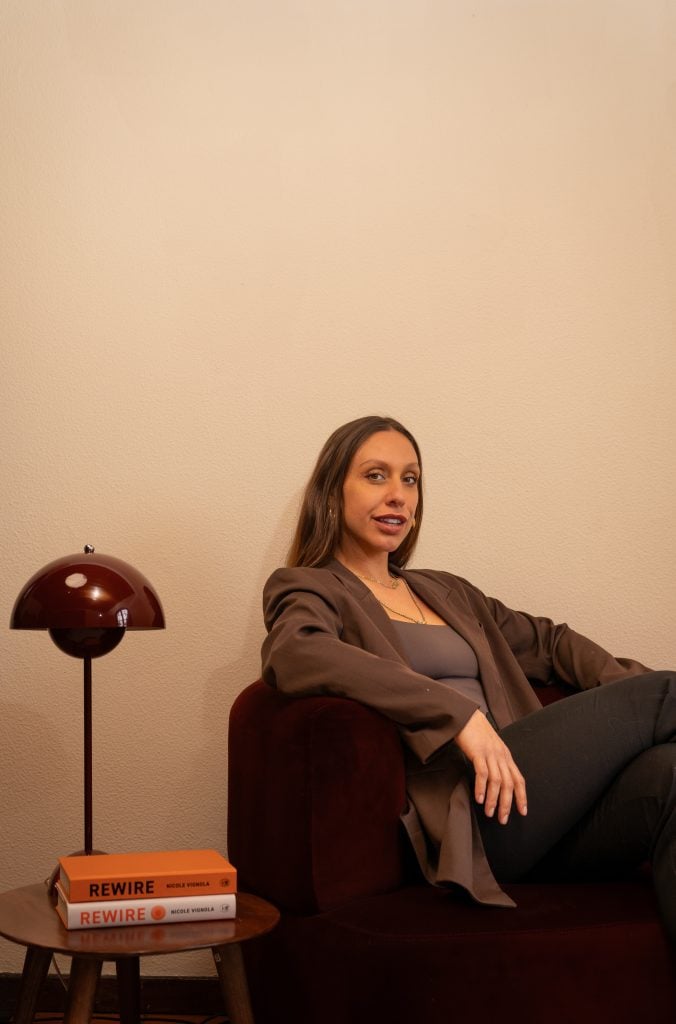
Photo provided by Nicole Vignola
What’s the most stubborn negative belief you’ve personally had to rewire, and what surprised you about the process?
Oh, this one’s deep, but I’ll get real with you, haha. I grew up in a very toxic environment where love wasn’t modelled to me correctly. I observed a lot of co-dependency triangles and trauma bonding. So, at first, I repeated those same patterns by dating “the ones who always needed to be fixed”. I suppose I was trying to atone for my past without truly even realising it until I went to therapy. I had always mistaken love for this crazy, toxic feeling that came with passion. But I was wrong.
I then thought I broke the pattern, but I actually just swung the pendulum the other way. I then ended up dating without truly opening my heart, thinking that passion was the sacrifice you made for a safe love.
I got engaged to someone whom I loved, but I was never truly in love with. I don’t know if that makes sense, but he really was my best friend, but I don’t think either of us really ever looked at each other and thought well I can’t live without you. I thought then that’s what safe love was supposed to feel like… a little blasé and a little detached.
But I suppose that in retrospect, deep down, I didn’t think I could have both true love and passion, but also safety. I also knew that the concept of true love might be too painful for me to handle because only broken people could love me. After all, I wasn’t good enough.
I wasn’t prepared to love someone so wholly that it would put me at risk of being hurt because I wasn’t sure I could attract someone decent and be madly in love with me. It was like it should be one or the other: Until I told myself that I could have both. I could have a passionate love that was safe. But that meant putting my heart at risk of breaking. But courage is to love somebody fully, even when you can predict the outcome. Brene Brown says that “To love someone is to be vulnerable because it’s to risk grief and loss”. That engagement had served its purpose because he was a kind man, and he was safe; he was also my best friend. But at the crux of it, I don’t think either of us truly was head over heels for each other. It was a very kind separation.
And so the great rewiring (as I like to call it) was when I promised myself that I wouldn’t settle, that I could have it all, that I was worthy of being loved by someone whom I was madly in love with. And the moment I made that promise to myself, my boyfriend came onto the scene and swept me off my feet, and he is my greatest love. It makes me realise that I don’t think I was truly ever in love before. The kind of love that they write about in poems. The kind of love that didn’t let me run from myself. It’s a common misconception that true love won’t trigger you, but this one triggered me the most because it wouldn’t let me hide. I had to learn to trust that I can truly love someone regardless of the outcome. To risk loss and to risk grief and real heartache. But that’s the price we pay for real love.
Pax and I met in a coffee shop four years ago. And unbeknownst to us both, his simple hello triggered a cascade of events that neither of us could have predicted four years later. He was visiting Bristol from New York, where he’s from, and I happened to walk in with my dog. The probability of two people being in proximity, within the same window of time and space… that is what I find truly remarkable, and then couple that with the choices we made to engage with one another so that our lives could briefly intersect. I find that combination of probabilities truly extraordinary. Anyway, we both went on our separate ways and lived completely separate lives for three years, until we reconnected again, and it was like the world had conspired in our favour the whole time.
So, I suppose to get to your question, rewiring is not always fun because you have to face your own insecurities and the narrative you’ve been telling yourself for all these years. But when you do the work, it is so incredibly worth it because you’re rewarding yourself with the most incredible life that is built by choice. I decided I was good enough, I decided I could have it all, and that’s exactly what I got back. Pax is hot, tall succesful, and is a musician who has even written me some songs, I mean swoon! But more importantly, he is my biggest fan and is inspired by me every day in the way that I am inspired by him, which is what a successful relationship requires: two people always hyping each other up and building together.
What’s the most unexpected thing that shifts when someone finally breaks through a mental block?
I think it’s the clarity and the hindsight we gain from seeing things from a new perspective. We start to realise that we were capable the whole time, and it builds self-efficacy for the future. Because the more we prove to ourselves that we can do, the more we start to update our internal belief system to tell us if we are capable of doing anything, so every breakthrough is another piece of evidence to remind us that we can.
I loved reading your book; so inspiring with tangible actions to take to “rewire” our mindsets for good. Share a little bit about “Rewire” and your process behind writing it.
Rewire was bred from wanting people to truly realise that there is hope. Knowing that we can change our brains and we can change any pattern that has been holding us back is our true superpower. Most people don’t even realise who they are or how amazing they are or how amazing they could be when they start to believe in themselves, and that’s why I wrote Rewire.
The process was quite interesting because I remember having to tap into two different parts of me. I remember writing the skeleton of the book 1st which was the scientific backbone, but of course nobody wants to read an academic book so I had to lift it with real stories and charming inspiration, so I remember having to almost peel off the hard layers of the onion to get to the core that was soft so that I could insert some Magic into it. I don’t know if that makes sense, but it’s almost like I ride it with two different brains, haha.
We heard you’re writing a second book, congratulations! How will this book differ from “Rewire,” and what new territory are you exploring that excites you most?
I think I answered above already, but I’ll add a little bit more. Mental Currency invites us to truly pay attention to what is important in life. So many people die with regrets of not having lived a life that was true to themselves. It’s like I almost want someone to look back on their 90th birthday and think about whether they loved their life and did what they truly wanted. To look back and reflect on how they spent their mental currency. The average person can waste up to a decade of their life scrolling social media whilst simultaneously complaining that they’re unhappy with the life they have. And so it’s empowering the reader to understand that through allocating their mental currency appropriately, they can build the life they want. One that they’re proud of.
Share the links to your website, where to buy your books, social handles, etc.
https://geni.us/REWIRE
https://substack.com/@nicolesneuroscience
https://www.instagram.com/nicolesneuroscience
https://www.nicolesneuroscience.com