
From Monet on a Swatch to Twombly interpreted in diamonds, a look at some of the ways art is making its way into what we wear.
Lately I’ve been realizing how much what I love today was influenced by my sister. Case in point: art. Amongst my friends and colleagues, I’m known as someone who is truly passionate about art and the art industry, but in reality, I think my sister is probably responsible for this, and specifically for my love of Monet.
Growing up, her room had prints of Monet, Klimt, Matisse and Van Gogh, and when we spent summers visiting my grandparents in Paris, she was the one who actually wanted to go to museums. I enjoyed the visits because it was fun to walk around Paris and spend time with my cousins, but my sister would read the descriptions, listen to the audio guides and take her time. I was usually ready to move on considerably sooner. Little did I know that all of those hours waiting for her were actually converting me into a lifelong art lover.
Years later, after visiting the Musée de l’Orangerie, I bought a bracelet in the museum shop with a fragment of Monet’s water lilies on it. I don’t remember how much it cost, or even exactly when I bought it. I do remember wanting it the moment I saw it though. Which brings us to this article, actually, and the concept of wearable art.
I came across that bracelet recently while looking for something in my jewellery stand, and it prompted me to think about wearable art. It is so often talked about as though it is a relatively new idea, but in reality, it isn’t. People have always found ways to bring the art they love into their homes and lives. The options have just become much broader, and in some cases considerably more expensive.
Here are a few that caught my attention.
OBL Jewellery
I admit, OBL is not a brand that I was familiar with before researching this article. I love that it’s a small business, and I also love that they are based in Granada, Spain, because that immediately brings back memories of visiting the Alhambra. But alas, that is a story for another day.
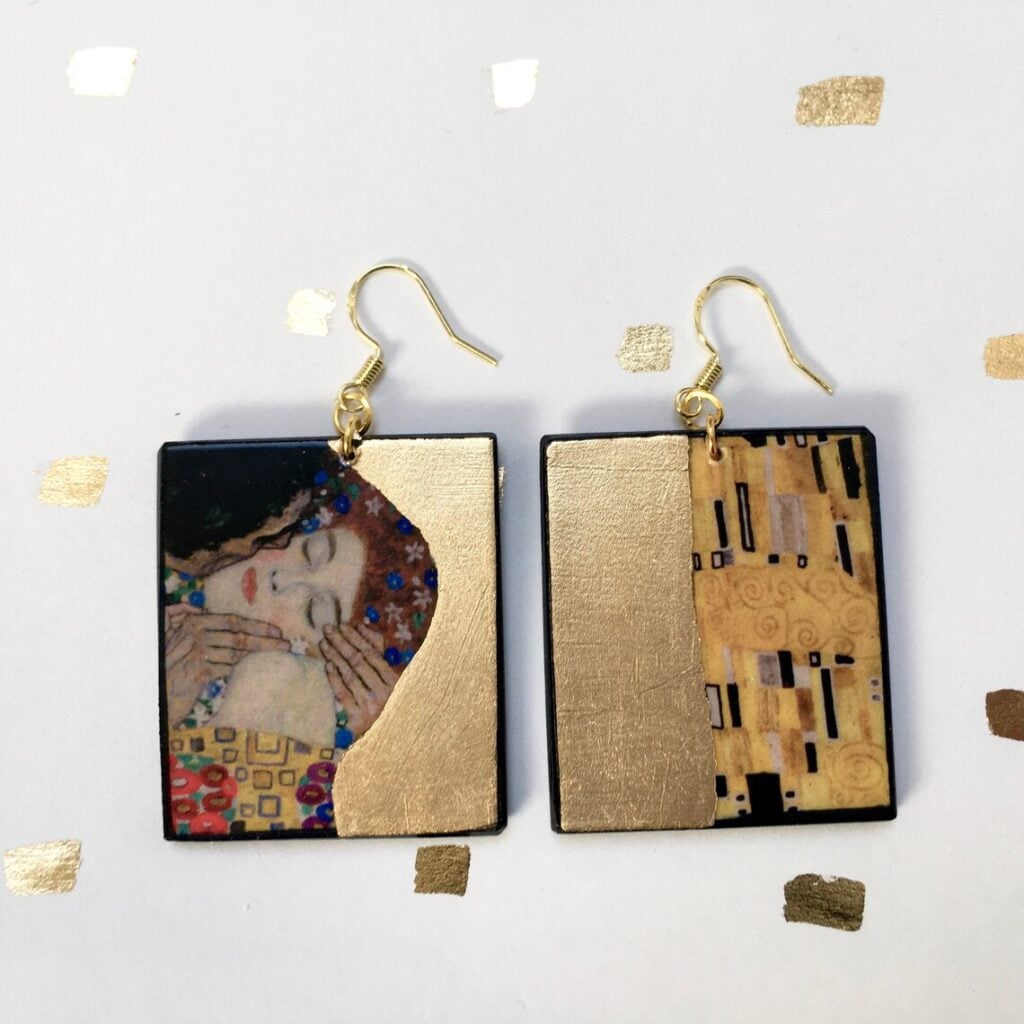
Image courtesy of OBL
This independent jewellery designer turns sustainably sourced wood into pieces inspired by specific works of art. Bosch’s Garden of Earthly Delights becomes a tiny triptych necklace, Klimt turns into earrings, and Mondrian becomes a statement ring. There are references to individual artists, movements and, my personal favourite, a collection called Women in Art, which honours both female artists and works inspired by the beauty of women.
There is no huge luxury house or museum campaign attached to any of it, just a seemingly beautiful passion for art and jewellery. Definitely something that I can get behind.
We spend a lot of time talking about major art collaborations, but sometimes the connection between art and what we wear is simply someone seeing a painting, loving it and thinking, I could turn that into something.
Swatch x Guggenheim, Monet’s Palazzo Ducale
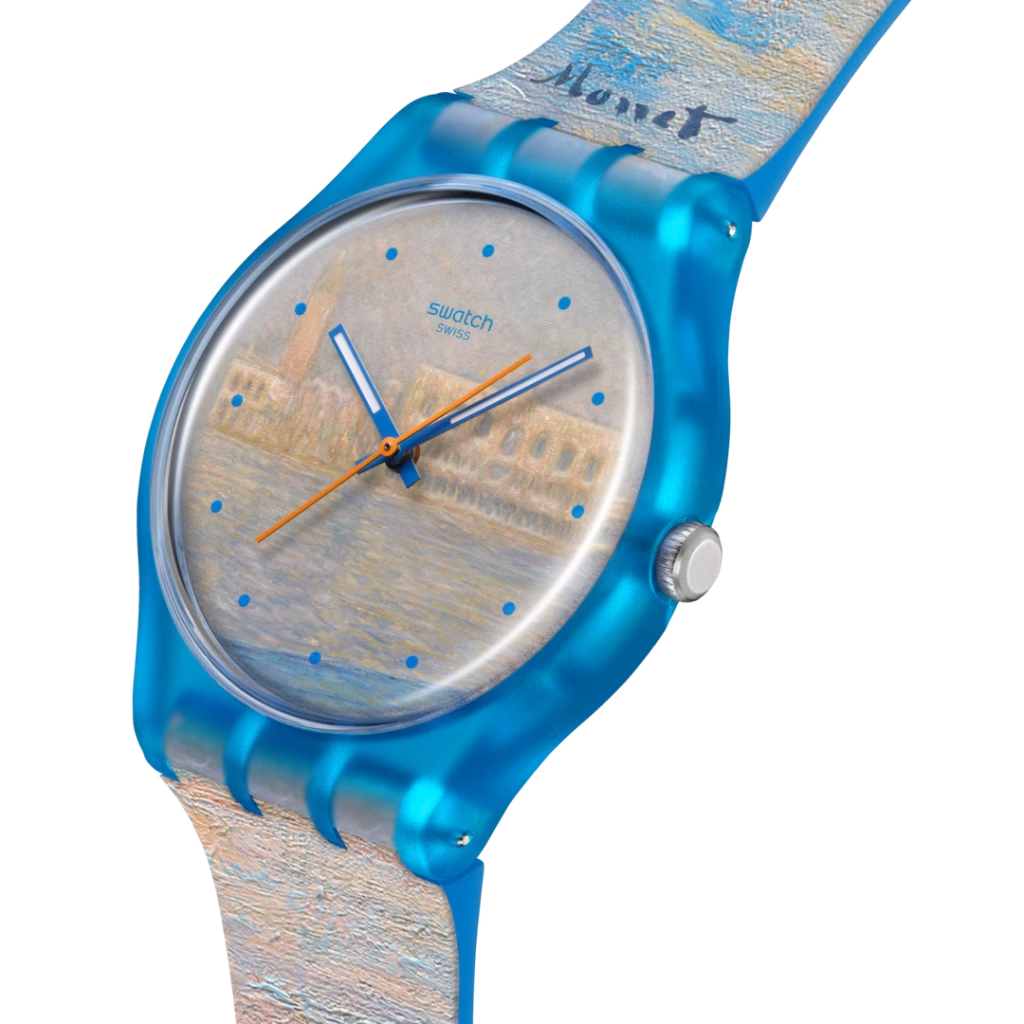
Image courtesy of Swatch Canada
I am going to admit my bias upfront on this one. Put Monet on almost anything and I am probably going to stop and look.
As I mentioned earlier, my sister may have been responsible for first introducing me to his work, but over the years my love for Monet became very much my own. I have spent time surrounded by the Nymphéas at l’Orangerie, bought the aforementioned bracelet, and eventually made my way to Giverny, something I had wanted to do for years. More on Giverny later though, because there is another piece in this article that takes me back to that particular visit much more directly. For now, let’s talk about Swatch.
Part of the 2026 Swatch x Guggenheim collection, Monet’s Palazzo Ducale takes inspiration from The Palazzo Ducale, Seen from San Giorgio Maggiore, painted by Monet in Venice in 1908. The artwork extends across the dial and strap, and one of my favourite details is that, when exposed to UV light, the dial glows orange. It might seem somewhat typical. After all, lume is hardly new in the watch world. But in this case it feels particularly appropriate when you consider how much of Monet’s work was about capturing the effects of changing light.
Swatch, of course, has been doing this sort of thing for decades, working with both individual artists and major museums. What I like about this particular watch is that you don’t necessarily need to know any of that history to enjoy it. You might buy it because you love Monet. You might have a personal connection to Venice. Or honestly, you might just really like the combination of turquoise, blue and orange. For $155, it is also one of the more accessible ways on this list to quite literally wear a masterpiece on your wrist. And perhaps because of that old museum-shop bracelet, there is something about this one that I inherently understand. Sometimes you see a piece of art you love and simply want to take a little bit of it home with you.
Tiffany & Co., Paloma’s Graffiti Love Ring
Picasso, of course, is one of the most recognizable names in the art world. It is next to impossible to find someone who has never heard of Pablo Picasso. In this case, however, we are talking about his daughter, Paloma.
To provide a bit of the backstory, Paloma Picasso began designing for Tiffany & Co. in 1980, and her Graffiti collection was inspired by the graffiti she saw across New York. The Love Ring, one of my personal favourites, takes her own handwritten version of the word “love” and wraps it around the finger. Sure, it sounds simple enough, but it is also a fascinating example of something associated with the street being translated into precious metal and luxury jewellery. Interestingly, while I have plenty of memories and associations with the Picasso name from my time at Christie’s, what pulled me into this collection was actually the graffiti inspiration.
Walk through almost any city and you are bound to find graffiti somewhere. In some places it is celebrated, think Graffiti Alley in Toronto, while in others it is highly frowned upon. Whatever the case, I have always felt that street art can act as a sort of barometer for what people are thinking, feeling or experiencing at a particular moment. There is a freedom to it: the ability to express yourself, sometimes anonymously, and put something out into the world for anyone passing by to see.

Image courtesy of Mural Routes
And then there are the pieces that become part of your own relationship with a city. For me, that has always been Toronto’s Rainbow Tunnel, tucked beneath the Don Valley Parkway near the East Don Trail and Moccasin Trail Park. I have been looking at that rainbow for as long as I can remember. When I was younger, coming home late from my parents’ store, seeing it meant we were almost home. As I got older, it simply became one of those familiar sights that would make me smile whenever I passed it.
Obviously Paloma Picasso’s Love Ring has nothing directly to do with my own graffiti memories, but that is also what I find interesting about the collection. Street art has a way of attaching itself to a place, a memory or even a period of your life. It becomes part of how you experience a city. I find something brilliant in taking a form of expression that can feel temporary, rebellious and deeply tied to the street, and translating it into something as permanent and precious as jewellery. Sometimes, simply recognizing something familiar in the inspiration behind a piece is enough to make you fall in love with it.
AYA Optical x Donald Chrétien
Next we have AYA, a brand that caught my attention for an entirely different reason. In this case, it was actually the history of the brand that pulled me in. AYA was built around the idea of using eyewear as a canvas for Indigenous art, with Corrine Hunt as its first artistic partner. Unbeknownst to the team at AYA at the time, Hunt was about to become part of one of the defining visual moments of the Vancouver Olympics. She had been selected to co-design the medals for the 2010 Vancouver Olympic and Paralympic Winter Games.
Having lived in Vancouver until 2010, and being there during the Olympics, anything that ties back to BC tends to make my ears perk up. So while that connection technically has very little to do with the glasses themselves, discovering that an artist whose work played such a visible role in that moment of Vancouver’s history was also part of AYA’s story made the brand feel unexpectedly familiar to me. What I also love about AYA is that it didn’t stop with one artist. The brand has continued to collaborate with numerous Indigenous artists over the years.
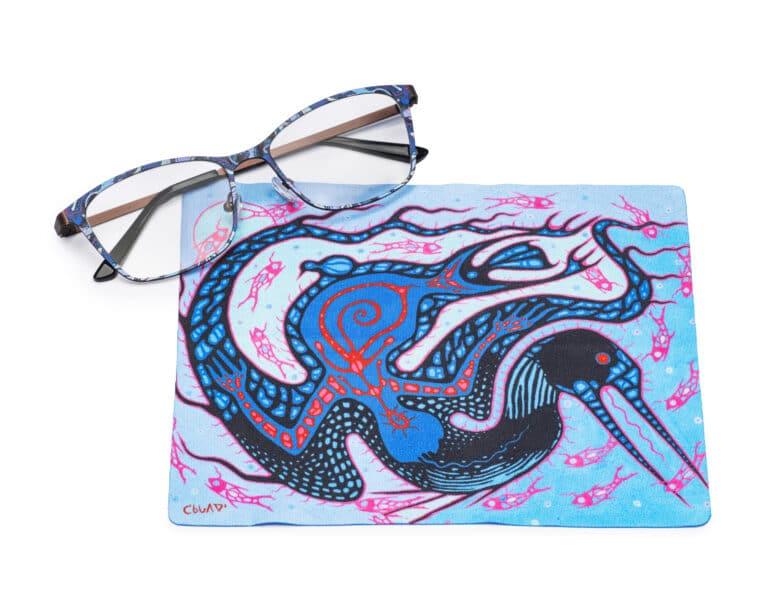
Image courtesy of AYA
The frames that initially drew me in feature the work of Ojibwe artist Donald Chrétien, whose Woodland-style work explores his Ojibwe heritage through colour and imagery. His designs are integrated into the frames themselves, including the Horizon and Breeze styles, but what I especially like is that the artwork does not simply end there. Each pair comes with a microfibre cleaning cloth featuring the artwork at a larger scale, giving you a much better sense of the piece that inspired the design.
AYA also treats its artists as partners, paying commissions and royalties while making an effort to share the stories behind the work rather than simply using Indigenous imagery as decoration. For me, that is what makes this interpretation of wearable art so interesting. Yes, the frames are beautiful, but you also know whose art you are looking at and where it comes from. The story stays attached to the piece.
Graff, Inspired by Twombly
Cy Twombly is another artist whose work I feel particularly attached to. I will admit, though, that this particular love affair took a little longer to develop. I first came across Twombly while I was working at Christie’s. In reality, I wasn’t entirely sure that I understood him. His catalogue of work includes pieces that, if you look at them quickly, can genuinely appear to be a series of scribbles on a canvas. But the more I learned about Twombly, and the more time I spent looking at his work, the more interested I became in the way painting, writing and drawing seem to blur together. A few years later, I saw his nine monumental Untitled I–IX paintings displayed together at Louvre Abu Dhabi, quickly transforming that room into one of my favourite spaces in the museum.
I unfortunately do not get to travel back to Abu Dhabi on a regular basis, but whenever I am there, it has become something of a ritual for me to spend an afternoon with Twombly. To explain just how much it means to me, on one particular trip I had managed to injure myself badly enough that walking around a museum was probably not the wisest idea, and yet there I was, hobbling through Louvre Abu Dhabi because I wanted to see the Twomblys again.
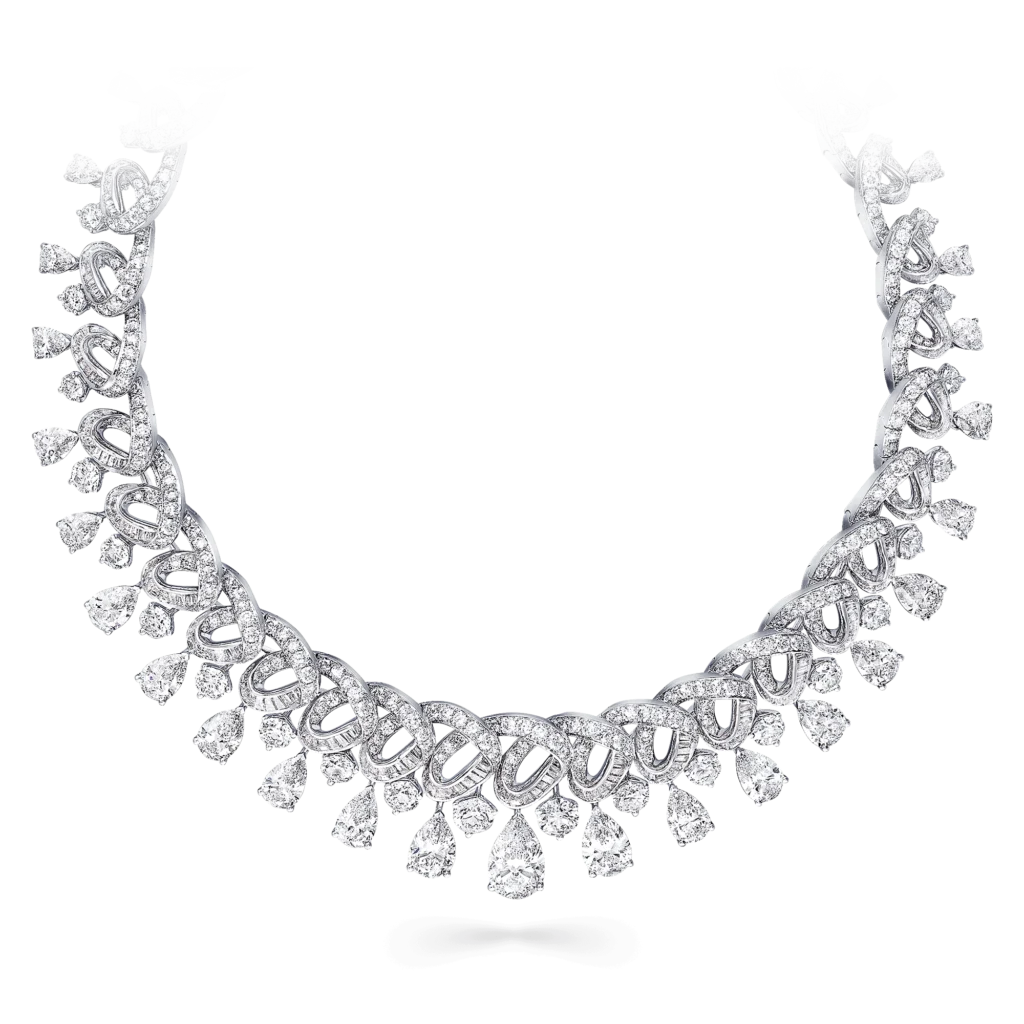
Image courtesy of Graff
Which is why Graff’s interpretation caught my attention. The collection was actually inspired by Laurence Graff’s own love of modern and contemporary art, including Twombly. I must say, I relate to that immensely. Rather than putting one of Twombly’s paintings onto a piece of jewellery, Graff took those sweeping, calligraphic lines and translated them into diamonds and rubies. The stones loop around the neck, curve across earrings and circle the finger in a way that immediately recalls the movement in Twombly’s work without ever actually reproducing it. And, because this is Graff, the scale is rather spectacular. One diamond necklace used 1,071 individual stones totalling 83.58 carats, set around a 4.06-carat pear-shaped diamond.
What I love most about the collection is that it approaches the idea of creating wearable art differently from the others. The connection is much more abstract. What Graff has taken from Twombly is not a particular painting, but the movement of his hand.
Frey Wille, Hommage à Claude Monet
Remember when I said we would come back to Giverny? Here we are.
Somehow, through all my years of visiting Paris growing up, and even through living there, I still had not made the trip to Giverny. It wasn’t until I was living in London that I finally went, while visiting Paris for the weekend to see my nephew.
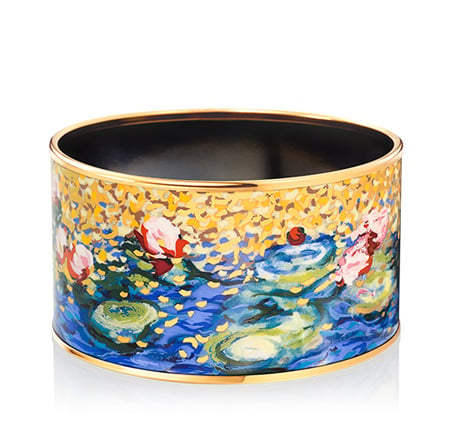
Image courtesy of FREYWILLE
In a somewhat ironic, yet very fitting-for-the-times moment, one of my clearest memories of the day involves an argument about smartphones. My nephew works at Apple and, naturally, had the newest iPhone. I, on the other hand, was using a new non-Apple device that was meant to have a great camera. Before we even reached Monet’s water lily pond, we had already started comparing whose phone could take the better photographs of the flowers in the garden. The competition continued through to the actual water lilies – and while I may have beautiful pictures to look back on today, the wearable art from Frey Wille still really resonates with me.
In particular, Frey Wille’s Hommage à Claude Monet collection immediately takes me back to Giverny. The Vienna jewellery house uses fire enamel to interpret the atmosphere of Monet’s garden, with designs inspired by his water lilies, irises and the colours of Giverny. The current collection includes everything from rings and pendants to bangles, including the Orangerie pieces inspired by Monet’s famous Nymphéas. Who knew that the iPhone debate was unnecessary? Apparently all we really needed was one of these pieces to capture the colours of the gardens.
Of everything in this article, this is probably the piece where the emotional connection is easiest for me to explain. I have stood beside that pond. I remember the colours, the garden and, apparently, the great iPhone battle of Giverny. A bracelet obviously cannot recreate any of that, but I don’t think that is really the point. Sometimes an object simply reminds you of somewhere you loved being. And for me, those colours do exactly that.
Louis Vuitton x Yayoi Kusama
Saving the most emotional piece for last.
Transparently, this section was a little difficult for me to write. For those who may not know, Yayoi Kusama died in Tokyo on August 14, 2026, at the age of 97, after spending more than seven decades creating incredible work across painting, sculpture, installation, performance, writing and more.
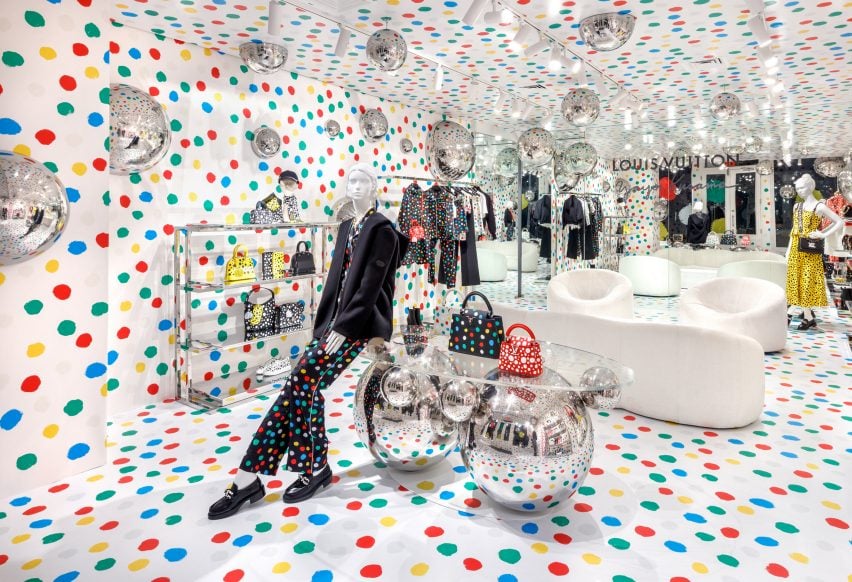
Louis Vuitton x Yayoi Kusama is a slightly different inclusion on this list because, unlike the other pieces, most of the collection is no longer officially available. I still could not bring myself to leave it out. Louis Vuitton first collaborated with Kusama in 2012, before returning to the partnership on a much larger scale in 2023. Her signature dots appeared across bags, jewellery, shoes, ready-to-wear and perfume, while Louis Vuitton storefronts around the world were transformed into enormous installations. It was not exactly subtle. Anyone who passed a Louis Vuitton during the height of the 2023 collaboration was bound to have seen Kusama’s work.
Her dots have such a recognizable visual identity that they did not disappear when placed beside the Louis Vuitton Monogram. If anything, there were pieces where I would argue the opposite happened: you saw Kusama first and Louis Vuitton second. That becomes even more interesting when you consider that the dots were never developed simply as decoration. Kusama connected them to visual experiences she began having as a child, and repetition became part of her exploration of infinity and what she called self-obliteration throughout her career.
One piece that remains listed on Louis Vuitton’s Canadian website is the LV x YK Boîte Chapeau 30 at C$13,600. It is a traditional hat box, so not exactly wearable art, but it remains one surviving piece of what has become a pretty iconic collaboration.
For me, Louis Vuitton x Kusama belongs in this article because it shows what can happen when the artist’s identity is every bit as powerful as the fashion house’s. It did not feel as though Louis Vuitton simply borrowed her dots. For a while, it felt like Kusama had taken over Louis Vuitton. Which, when you think about the scale and power of that particular luxury house, is quite an achievement. Which brings me back to the Monet bracelet that started this whole train of thought.
There is very little connecting a piece of wooden jewellery from Granada, a pair of Indigenous art-inspired glasses, a diamond necklace worth an undisclosed amount and a Louis Vuitton bag covered in Kusama dots from a product perspective. They sit at completely different price points, come from completely different corners of the industry and interpret art in very different ways.
My sister covered her room with prints because she wanted to live with art that she loved. Years later, I walked out of l’Orangerie wearing a little piece of Monet around my wrist. Neither of us thought of it as “wearable art” or an art-fashion crossover. We just liked something and wanted it around us.
Maybe, underneath all of the collaborations, diamonds, museums and luxury houses, it really is still as simple as that. We see something we love, connect with the story behind it, and find a way to keep a little piece of it with us.